Since 9 October 2026, many clicks from ChatGPT reach websites without any sign of where they came from. There is no referrer and no utm_source=chatgpt.com parameter. Analytics tools therefore file these visits under "Direct". The ChatGPT number in your report drops, even though the data so far suggests the visitors keep coming. Cedric Huesler from Adobe analysed around 500 pages: ChatGPT visits there fell by about 31,000 per day, while direct visits rose by about 26,000 per day (Search Engine Roundtable, 14 October 2026). OpenAI has not announced a fix so far.
Key takeaways
Since October 2026, links in many ChatGPT answers no longer carry the utm_source=chatgpt.com parameter, and no referrer arrives either.
Without both, the visit counts as "Direct". In GA4 it then no longer lands in the "AI Assistant" channel.
Based on the data so far, mostly the measurement has dropped. Across around 500 pages, about 31,000 fewer ChatGPT visits and about 26,000 more direct visits arrived per day.
No analytics tool can recover a source value that was never sent.
Add an annotation for 9 October 2026 and analyse ChatGPT and Direct together from that day on.
What changed in ChatGPT
ChatGPT has been adding the utm_source=chatgpt.com parameter to links in its answers since 2025. In June 2025 it was added to the extra sources under "More" as well (Search Engine Roundtable, 16 June 2025). In October 2026 it disappeared again from many links. According to Search Engine Roundtable, this apparently started with the release of GPT‑6. There are two explanations for the cause, and they do not rule each other out.
Cedric Huesler says GPT‑6 opens links with this call:
window.open(url, "_blank", "noopener,noreferrer")
The noreferrer option has a clearly documented effect: the browser omits the Referer header. It also treats the new window as if noopener were set. Because the UTM parameter is missing at the same time, the target page gets no hint at all that the visit came from ChatGPT.
Profound, on the other hand, attributes the drop to the new "Intelligent UI", in which ChatGPT answers with interactive elements. In the answers Profound collected, about 98% of answers with sources had at least one tagged link on 8 October. On 9 October it was 75%, on 14 October 66%. Over the same period, the share of answers in the Intelligent UI rose from 2% to about 35%. There are exceptions: links that only appear after opening an additional product or information panel still carried the parameter. Whether a source is recognised therefore also depends on which link someone clicks.
Why a missing referrer turns the visit into "Direct"
The referrer is the address of the previous page. The browser sends it to the target page in the HTTP header Referer. Not much came through from ChatGPT before either. The browsers' default rule, strict-origin-when-cross-origin, sends only the origin when moving to another domain, so https://chatgpt.com/ and not the individual conversation. That was enough to recognise the source, though. The UTM parameter was a second, independent way to do so. Now both signals are gone.
Google Analytics 4 shows what happens next. According to its definition of the default channel group, GA4 assigns the "AI Assistant" channel in only two cases: the medium is "ai-assistant", or the referrer matches a list of known AI assistants. If neither a referrer nor a UTM parameter arrives, the session is classified as "Direct". Google describes this channel as arriving via a saved link or by entering the URL. To GA4, a click from a ChatGPT answer looks like a bookmark.
What it means for your numbers
The examples in the table are made up and show the typical pattern:
Metric | What happens | Example |
|---|
ChatGPT or "AI Assistant" | drops sharply from 9 October | A guide that used to get regular ChatGPT visits now shows almost none |
Direct | rises, especially on deep pages | A long product comparison URL suddenly gets many direct visits, although hardly anyone types it in |
Conversions by source | ChatGPT loses its share, Direct gains it | Someone gets a product recommendation in ChatGPT, buys it and is counted as "Direct" |
Organic search | stays within the usual range | In Huesler's data, search on the affected pages fell by 7%, the same as everywhere else |
Time series | get a break | A comparison of October against September shows a ChatGPT drop that is purely about measurement |
Huesler also observed that direct visits rose on two out of three pages that lost ChatGPT visits. In the week before, that was a coin flip. The new direct visitors also resemble ChatGPT visitors. On mobile devices, the share of people who saw the cookie banner for the first time, meaning they were new to the site, rose from 36% to 44%. For ChatGPT visitors this value was 55%. The analysis only covers the days from 9 to 13 October, though.
How to analyse ChatGPT traffic from now on
You won't get the exact ChatGPT number back. But you can narrow down where the visits are counted now. Work in this order:
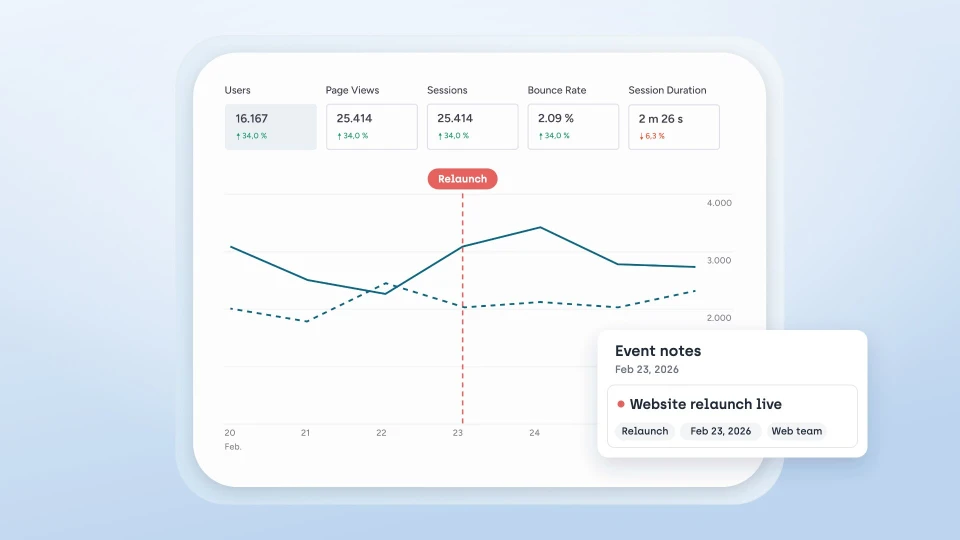
Add an annotation. Mark 9 October 2026 in your analytics tool and in every report used to judge your performance. Explain the break to everyone who reads these reports.
Pick the affected pages. Take the pages where ChatGPT used to bring a large share of visits. Huesler used pages with at least 5% ChatGPT share.
Add up ChatGPT and Direct. On these pages, compare the sum of both channels before and after the cut-off date. If the sum stays about the same, mostly the measurement was lost and not the visits.
Compare behaviour. Check whether direct visits behave differently since 9 October than before: more new visitors, different entry pages, different reading time.
Check the big picture. Look at all visits and conversions together. Profound advises not to change strategy based on the ChatGPT number alone if only that number has dropped.
A typical mistake is step 5 in the wrong direction: the content budget gets cut because a channel seems to collapse, when only its label is missing.
Our campaign analysis works well for step 4. It gives every source an activity score that combines goals, bounces, reading time, scroll depth and pages per visit. The average visit has a score of 1.0×. Sources are rated once they have at least 30 visits in the selected period. If the score for "Direct" changes clearly after the cut-off date, that points to new visitors in this channel. From every source you can open the journeys and see which pages these visitors view next. But we can't show a source that the browser never sent either.
Frequently asked questions
Does ChatGPT send fewer visitors now?
The data so far points to something else. On the around 500 pages in Huesler's analysis, almost as many direct visits were added as ChatGPT visits were lost. After only a few days, that is not proof yet.
Can I get the referrer back on my site?
No. Whether a referrer is sent is decided by the page that opens the link, in this case ChatGPT. Settings on your own website can't change that.
Do my own UTM parameters help?
Only for links you create and share yourself, for example in a newsletter. ChatGPT creates the links in its answers itself. Also, never add UTM parameters to links within your own website. Otherwise they overwrite the original source of the visit.
Do ChatGPT visits still show up under "AI Assistant" in GA4?
Only if the referrer arrives or the medium is "ai-assistant". Some links still carry the utm_source=chatgpt.com parameter, for example links in additionally opened panels. These visits keep the source chatgpt.com. If both the referrer and the parameter are missing, the visit lands in "Direct".
Will OpenAI reverse the change?
That's open. Profound expects a fix but has not seen any official announcement. Even if the tagging comes back, the weeks without it stay stored as "Direct" in your data.