More reach, better user experience, and inclusive web design through web analytics and accessibility.
A successful website is more than just an attractive surface. It has to be user-friendly, accessible, and powerful for all users, regardless of their abilities or limitations. Two key areas that are becoming increasingly important in this context are web analytics and digital accessibility. At first glance these topics may seem independent, but their interplay is essential in order to maximize a website's reach, performance, and user experience.
Digital accessibility describes designing websites, apps, and other digital products so that they are accessible to all people, regardless of physical or cognitive limitations. The goal is to remove obstacles and enable an equivalent experience for all users. To achieve this, various measures are put in place, for example screen reader compatibility for blind or visually impaired people, the option to use the keyboard for users with motor limitations, and the use of color schemes and contrasts that can also be perceived by people with color vision deficiencies. These adjustments follow international standards such as the Web Content Accessibility Guidelines (WCAG). Accessibility is not only a moral obligation or legal requirement, for example through the German Accessibility Strengthening Act, it is also a strategic advantage. An accessible website reaches a larger audience and improves the user experience for everyone.
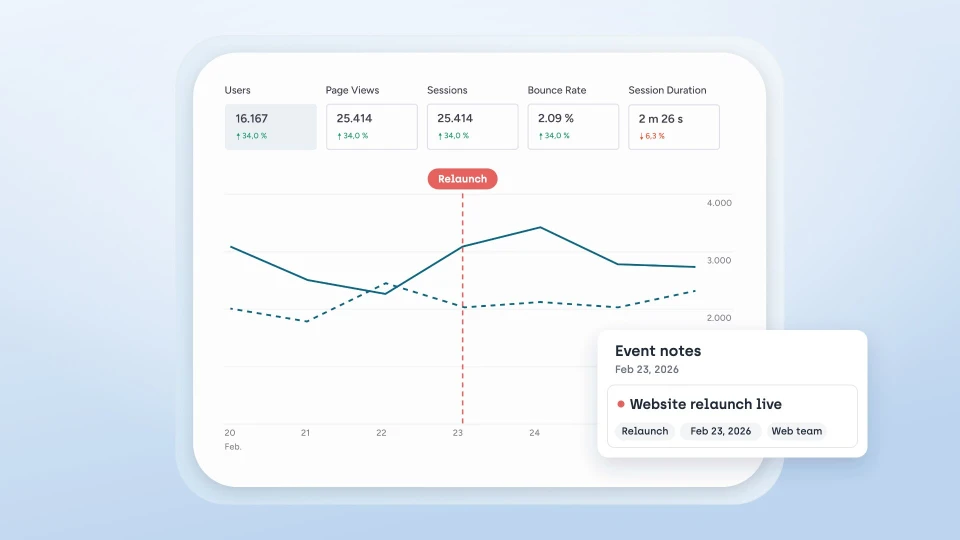
Alongside accessibility, web analytics plays a central role in the digital space. It provides the foundation for data-driven decisions by collecting, analyzing, and interpreting data about user behavior on a website. Tools like Google Analytics and other specialized platforms deliver valuable insights into aspects such as the most popular pages, bounce rates, time spent by users on the website, and the devices or browsers used. This information lets companies optimize their websites in a targeted way, whether through improved content, faster load times, or more intuitive design.
Together, digital accessibility and web analytics form two essential pillars of a successful online presence: while accessibility ensures that digital offerings are accessible to all people, web analytics helps continuously improve these offerings and adapt them to users' needs.
Why web analytics and digital accessibility belong together
Combining web analytics and digital accessibility offers not only a comprehensive view of user behavior, but also concrete approaches for optimization. Here are five reasons why both topics are inseparably linked:
1. Accessibility improves the user experience. Web analytics reveals optimization potential
Web analytics provides detailed information about how users move around on a website and where problems occur. If, for example, a high bounce rate is detected on certain pages, this could indicate that these pages are not designed in an accessible way. Maybe the navigation is not accessible to screen reader users, or a button cannot be operated via the keyboard. By analyzing such data, targeted measures can be taken to improve accessibility.
2. Accessibility increases reach. Web analytics measures success
An accessible website reaches not only people with disabilities, but also older users or people with temporary limitations (e.g. a slow internet connection). This leads to a larger target audience and potentially more traffic. With web analytics you can measure precisely how reach has changed as a result of accessible adjustments, for example through longer time on page or a lower bounce rate.
3. Together toward better conversion rates
An accessible website ensures that all users can navigate the purchase process or other conversion steps without problems. If, for example, a form is not accessible, potential customers might drop off, which has a negative effect on the conversion rate. Web analytics helps you understand which elements of the website work particularly well and which need to be optimized. That creates a data-driven approach to improving accessibility and conversion rates.
4. Compliance as a competitive advantage
Many countries now have legal requirements for digital accessibility. Companies that meet these requirements not only avoid legal risks, they also position themselves as leaders in inclusion and social responsibility. Web analytics can help monitor whether measures actually take effect, for example by tracking user behavior of people using screen readers or other assistive technologies.
5. Accessibility boosts SEO. Web analytics shows the effect
Accessible websites are often also better optimized for search engines (SEO). Clear structures, alternative text for images, and fast load times benefit both people and search engines. With web analytics you can measure and analyze changes in visibility, for example through an increase in organic traffic after implementing accessibility measures.
Web analytics and digital accessibility are not separate disciplines. They complement each other perfectly and should go hand in hand. While accessibility ensures that all users have access to a website, web analytics provides the data foundation for targeted optimizations. Together they create an inclusive, user-friendly, and high-performing website.
Companies should therefore connect both areas strategically:
Implement tools to analyze user behavior.
Run regular accessibility audits.
Use insights from analytics data specifically to improve accessibility.
Communicate your efforts actively, because this strengthens your brand image and shows commitment to inclusion.
A successful website stands out by not only being visually appealing, but also serving all users, regardless of their individual needs. The combination of web analytics and digital accessibility is the key to that.